


Will AI Reshape Supply Chain and Wholesale Distribution?
Every few years, something arrives promising to fix supply chains. Most of it doesn't. AI is further along than most, but the gap between what's demonstrated and what's marketed is still wide.
So it's worth separating the two: what companies have actually deployed and measured, what's still ahead, and what a buyer should make of any of it.
Where Supply Chains Break Down
Distribution has the same recurring failure points it's always had: demand forecasts that miss, inventory that sits in the wrong place, order errors that surface too late to fix cheaply, and disruptions nobody planned for.
None of these are new. They're just expensive, and they compound. A forecast that's off leads to overstock or stockouts, and both cost money in different ways.
That's the problem AI is being pointed at: not replacing how distribution works, but reducing how often these specific things go wrong.
What AI Actually Does in a Supply Chain
Three capabilities account for most of the real applications.
Pattern recognition at scale. Machine learning finds relationships across large datasets that people would miss: seasonal patterns interacting with regional demand, or a supplier whose lead times quietly drift every fourth quarter.
Forecasting. Those patterns feed demand predictions, which drive inventory levels and reorder timing. This is where most of the measurable value has come from so far.
Real-time visibility and routing. Tracking goods in transit and adjusting dynamically when conditions change is the difference between finding out about a delay and responding to one.
Automating routine work also reduces error rates, which matters less dramatically than the forecasting gains but compounds steadily.
What Companies Have Actually Deployed
The clearest documented example is route optimization.
UPS built ORION On-Road Integrated Optimization and Navigation to sequence each driver's deliveries every morning.
According to INFORMS, which awarded the project its 2016 Franz Edelman Award, the system had saved UPS more than $320 million as of December 2015, with projected annual savings of $300–400 million at full deployment. It also cut an estimated 10 million gallons of fuel and 100,000 metric tons of CO2 per year.
That example is worth sitting with, because it shows the shape of realistic AI value: a narrow, well-defined problem what order should this driver make these stops in solved repeatedly at enormous scale. Not a transformed business. One decision, made better, a few hundred thousand times a day.
Amazon and Walmart have both applied similar approaches to warehouse operations, demand forecasting, and inventory turnover, with reported reductions in out-of-stock rates.

The Ethical Questions Nobody Should Skip
Applying AI to supply chains raises issues worth naming plainly.
Data privacy. These systems need large volumes of data, including information about suppliers, customers, and employees. How that's collected, stored, and used determines whether it's compliant and whether anyone trusts it.
Job displacement. Automation reduces demand for some roles. Companies that handle this well plan for retraining and redeployment before the technology lands, not after.
Algorithmic bias. A model trained on skewed or unrepresentative data produces skewed results, often invisibly. Systems need ongoing evaluation, not a one-time validation at launch.
Several major technology companies have published frameworks addressing these questions; Google's AI Principles is one of the more widely referenced. Whatever you make of them, they establish that transparency, accountability, and human oversight are expected rather than optional.
The practical version for any company deploying this: be able to explain how a system reaches its conclusions, have a process for when it gets something wrong, and keep people in the loop on decisions that matter.
What's Coming
A few developments are worth watching.
Generative AI is moving faster than most of the categories above, and its applications in procurement summarizing supplier documentation, drafting and analyzing contracts, and surfacing issues in large datasets are developing quickly.
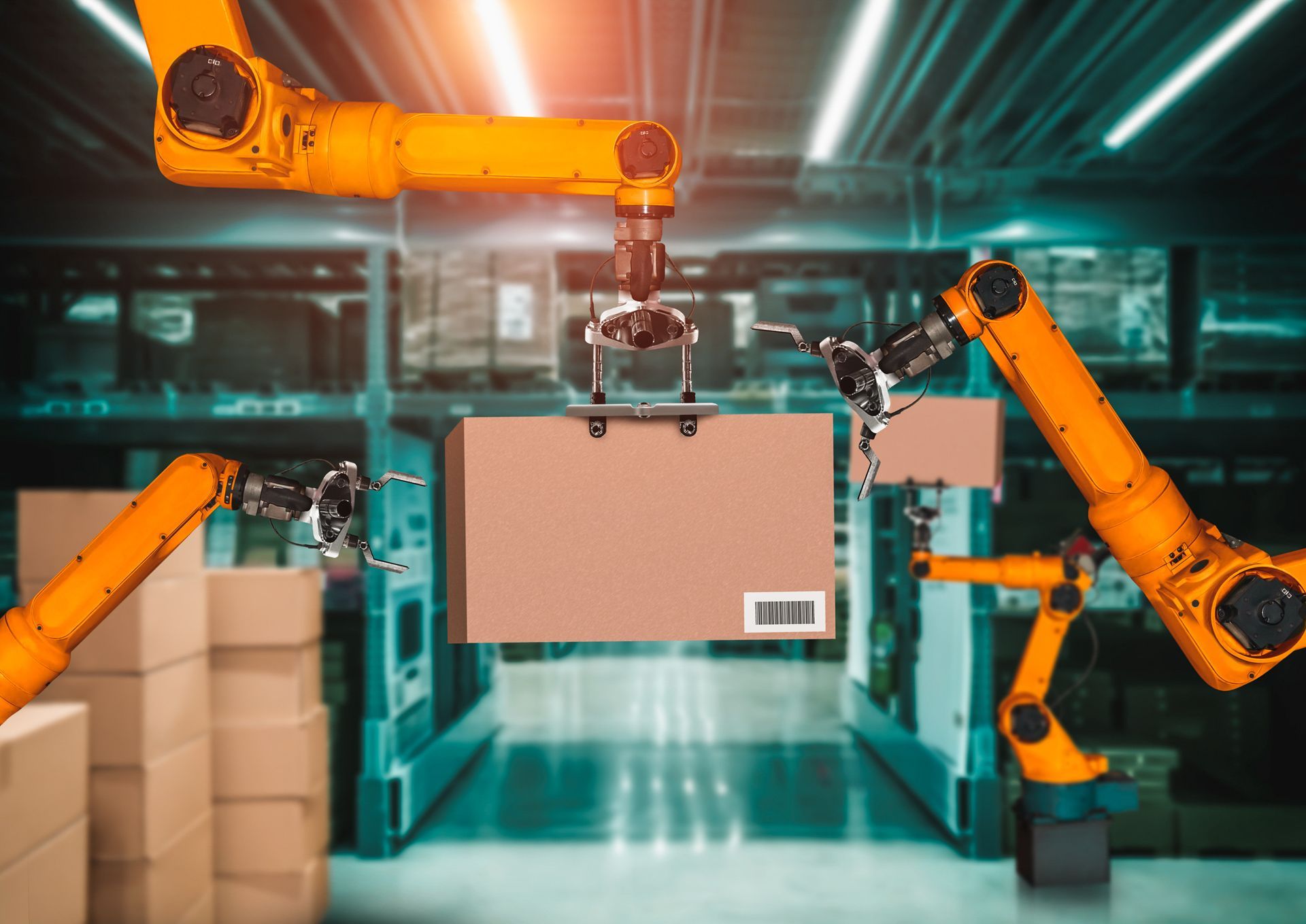
AI-driven robotics in warehousing continues to expand, handling picking and sorting tasks with increasing precision.
Blockchain paired with AI is discussed frequently as a transparency solution for provenance tracking. It's been discussed for years with limited deployment, so treat it as a possibility rather than a trend.
The broader shift is from reactive to anticipatory systems that flag a likely disruption before it lands rather than reporting one after. How close the industry is to that in practice, versus in vendor demos, varies considerably.
What This Means for Buyers
For anyone purchasing supplies rather than building these systems, the practical takeaway is narrower than the hype suggests.
AI is making some suppliers better at forecasting availability, routing shipments, and flagging problems early. That shows up for you as fewer surprises, not as anything visible in the technology itself.
It doesn't replace the fundamentals. A supplier with excellent forecasting and no inventory is still a supplier who can't fill your order. The questions worth asking haven't changed: can they source what you need, can they deliver when they said, and do they tell you early when they can't.
Contact Us For Custom Procurement Solutions
Where CHA Fits
CHA Supply is a wholesale distributor focused on direct, affordable sourcing across categories such as PPE, first aid, facility supplies, and more. We watch this space closely because anything that makes sourcing more predictable is worth paying attention to.
But our value to customers is straightforward: direct manufacturer relationships, consolidated ordering, and being reachable when something needs sorting out. As a woman-owned, WBENC-certified business, we also help institutional and government buyers meet supplier diversity requirements while doing it.
[Browse the full catalog →] or contact our team at support@chasupply.com or (984) 204-1637 x17.
===> Interested in seeing what we have in our inventory? Visit our online store here.
===> You can also shop for what we have on sale.


Leave a comment